
What Is It? The appendix is a small, finger-shaped pouch attached to the large intestine on the lower right side of your abdomen. When it becomes inflamed or infected — a condition called appendicitis — it requires urgent surgical removal. If left untreated, the appendix can burst, leading to a life-threatening infection.
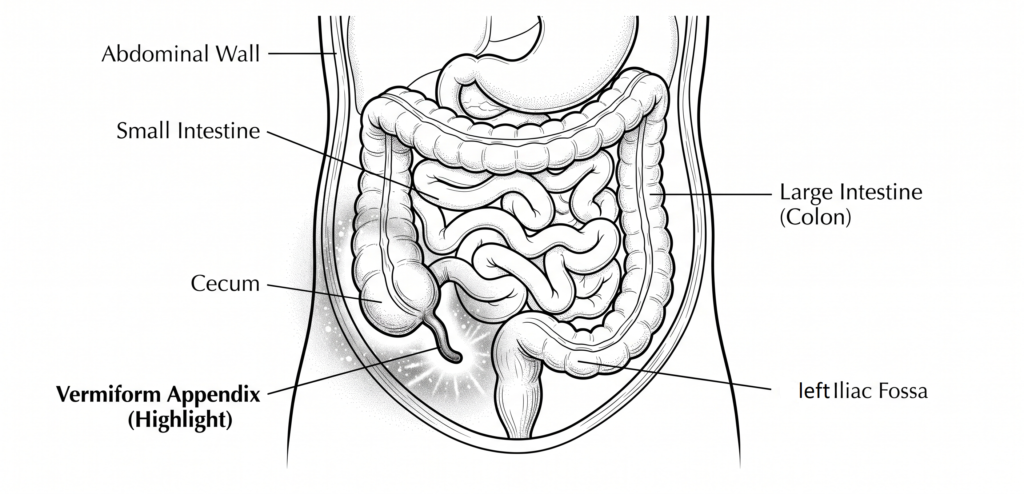
Symptoms
- Sudden pain that begins around the navel and shifts to the lower right abdomen
- Pain that worsens with movement, coughing, or deep breathing
- Nausea and vomiting
- Loss of appetite
- Mild fever that may rise if infection worsens
- Constipation or diarrhoea
When to See a Surgeon Appendicitis is a medical emergency. Go to Dr. Bhaskar or the nearest hospital immediately if:
- You have sudden, worsening pain in the lower right abdomen
- The pain is accompanied by fever and vomiting
- The abdomen feels rigid or board-like to touch
⚠️ Do NOT take painkillers or apply heat before seeing a doctor — this can mask symptoms and delay diagnosis.

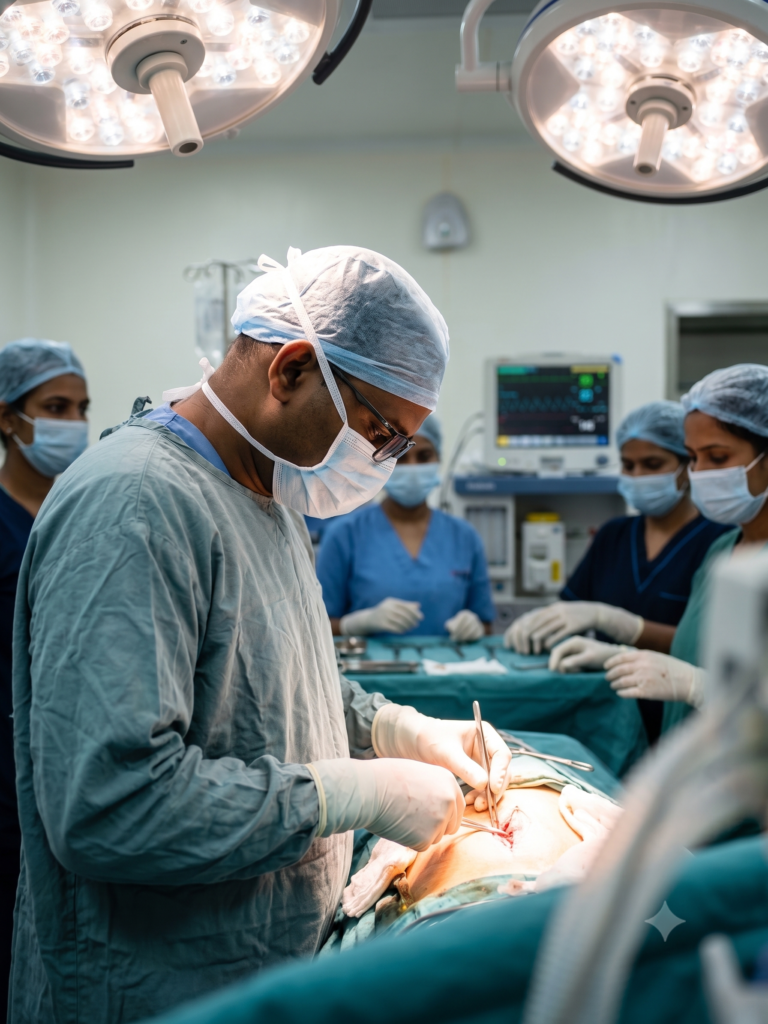
Dr. Bhaskar’s Approach Dr. Vivek Bhaskar performs Laparoscopic Appendectomy — removal of the inflamed appendix through small keyhole incisions. This method ensures minimal pain, faster healing, and reduced risk of wound infection. In emergency situations, Dr. Bhaskar’s swift decision-making and surgical precision have saved countless lives across Hazaribagh and surrounding areas.
Recovery Time
- Hospital stay: 1–2 days (laparoscopic)
- Return to routine: 5–7 days
- Full recovery: 1–2 weeks
👉 Don’t wait — early treatment leads to faster recovery. Contact Dr. Vivek Bhaskar today! 📞 Call / WhatsApp: +91-8521044949
FAQ — Appendix Surgery (Appendicitis) Dr. Vivek Bhaskar | Hazaribagh, Jharkhand
Q1. What is the appendix and what does it do? The appendix is a small, finger-shaped pouch attached to the large intestine on the lower right side of the abdomen. It has no essential function in the human body — meaning you can live a completely normal, healthy life without it. When it becomes inflamed or infected, it must be removed surgically.
Q2. What is appendicitis? Appendicitis is the inflammation or infection of the appendix. It is one of the most common surgical emergencies worldwide. It can affect anyone — children, young adults, and older people alike. Once diagnosed, it requires prompt surgical removal before the appendix bursts.
Q3. How do I know if it is appendicitis? What are the warning signs? The classic signs of appendicitis are:
- Pain that starts around the navel and shifts to the lower right side of the abdomen
- Pain that gets worse with movement, coughing, or deep breathing
- Nausea and vomiting
- Loss of appetite
- Mild to moderate fever
- Constipation or loose stools
If you or a family member has these symptoms together — especially worsening lower right abdominal pain with fever — go to Dr. Bhaskar or the nearest hospital immediately.
Q4. Is appendicitis always an emergency? Yes, appendicitis should always be treated as an emergency. The appendix can rupture within 24 to 72 hours of the onset of symptoms. A ruptured appendix spreads infection throughout the abdomen — a life-threatening condition called peritonitis. Early surgery is far safer than waiting.
Q5. What happens if appendicitis is not treated in time? If left untreated, the inflamed appendix bursts and releases bacteria into the abdominal cavity. This causes peritonitis — a severe, life-threatening infection. The patient may go into septic shock. Treatment then becomes far more complex, recovery much longer, and the risk to life significantly higher. This is why immediate action is critical.
Q6. Can appendicitis be treated with antibiotics alone without surgery? In some very mild, early cases, antibiotics may temporarily settle the inflammation. However, this is not a permanent solution — the appendicitis almost always returns, often worse than before. Surgery remains the standard, definitive, and safest treatment for appendicitis worldwide.
Q7. What is appendix surgery called and how is it done? The surgery to remove the appendix is called Appendectomy. Dr. Bhaskar performs Laparoscopic Appendectomy — a minimally invasive procedure using 3 tiny keyhole cuts on the abdomen. A small camera and instruments are inserted through these cuts to locate and remove the appendix. The entire procedure is done under general anaesthesia and typically takes 30 to 45 minutes.
Q8. What is the difference between laparoscopic and open appendix surgery? In laparoscopic surgery, 3 tiny cuts are made and a camera guides the procedure — resulting in less pain, minimal scarring, faster recovery, and lower risk of infection. In open surgery, a single larger incision is made on the lower right abdomen. Open surgery may be necessary in cases of a ruptured appendix with widespread infection or when anatomy is complex. Dr. Bhaskar will always choose the safest approach for each patient.
Q9. Is appendix surgery safe? Yes, appendix surgery is one of the most commonly performed and well-established surgeries in the world. Laparoscopic appendectomy is safe, effective, and routinely performed by Dr. Bhaskar with excellent outcomes. The risks are minimal when surgery is done before the appendix ruptures.
Q10. Will I be unconscious during the surgery? Yes. The surgery is performed under general anaesthesia — you will be completely asleep and feel absolutely nothing during the procedure. A qualified anaesthetist will monitor you throughout. Once you wake up, the surgery will already be done.
Q11. How long does the surgery take? A straightforward laparoscopic appendectomy takes approximately 30 to 45 minutes. In complicated cases — such as a ruptured appendix or abscess — the procedure may take longer.
Q12. How many days will I stay in the hospital?
- Laparoscopic appendectomy: 1 to 2 days
- Ruptured appendix or complicated cases: 3 to 7 days depending on recovery
Most patients are surprised at how quickly they feel better after a straightforward laparoscopic procedure.
Q13. How soon can I return to normal life after surgery?
- Walking: same day or next morning
- Light daily activities: within 3 to 5 days
- School or desk work: within 1 week
- Physical activity or sports: after 2 to 3 weeks
- Heavy manual labour: after 3 to 4 weeks
Dr. Bhaskar will give specific guidance based on your individual recovery.
Q14. Will there be a scar after appendix surgery? With laparoscopic surgery, there are only 3 tiny incisions — each less than 1 cm in size. These heal into barely visible marks within a few weeks. There is no large scar like in traditional open surgery.
Q15. What should I eat after appendix surgery? For the first 2 to 3 days, stick to light and easily digestible food — khichdi, dal, rice, soups, and curd. Avoid oily, spicy, or heavy food for at least 1 to 2 weeks. Stay well hydrated. You can gradually return to your normal diet as your body heals and your surgeon advises.
Q16. Can the appendix grow back after surgery? No. Once the appendix is removed, it does not grow back. You will never get appendicitis again after the surgery.
Q17. My child has severe stomach pain — could it be appendicitis? Appendicitis is very common in children and teenagers. It can sometimes be mistaken for general stomach pain, gas, or constipation. If your child has persistent lower right abdominal pain with fever, vomiting, or loss of appetite — do not give painkillers and wait. Bring them to Dr. Bhaskar immediately for evaluation. Early diagnosis in children is critical.
Q18. What should I NOT do if I suspect appendicitis?
- Do NOT take painkillers on your own — they mask symptoms and delay diagnosis
- Do NOT apply a hot water bottle or heating pad to the abdomen
- Do NOT eat or drink anything if you suspect you may need surgery
- Do NOT wait and hope the pain will pass on its own
- Go to the hospital or call Dr. Bhaskar immediately
Q19. Can appendicitis happen again after surgery? No. Once the appendix is removed, appendicitis cannot recur. However, occasionally a small stump of the appendix may be left behind and in very rare cases it can get inflamed — called stump appendicitis. This is extremely uncommon with modern surgical technique.
Q20. Do patients from surrounding areas come to Dr. Bhaskar for appendix surgery? Absolutely. Dr. Vivek Bhaskar is a trusted name for emergency and elective surgical care across Hazaribagh, Barhi, Barkattha, Vishnugarh, Barkagaon, Chouparan, Ramgarh, Chatra, Simaria, and the wider region. In emergencies, patients and families know they can rely on Dr. Bhaskar for swift, skilled, and compassionate surgical care at any hour.
Q21. How do I reach Dr. Vivek Bhaskar for appendix-related emergency or consultation? Call or WhatsApp immediately on +91-8521044949. Do not delay — appendicitis moves fast. The sooner you reach Dr. Bhaskar, the safer and simpler the treatment will be. Early surgery means faster recovery, fewer complications, and complete peace of mind for you and your family.