
Dr. Vivek Bhaskar | MS (Surgery) | Hazaribagh, Jharkhand
What is a Hydrocele?
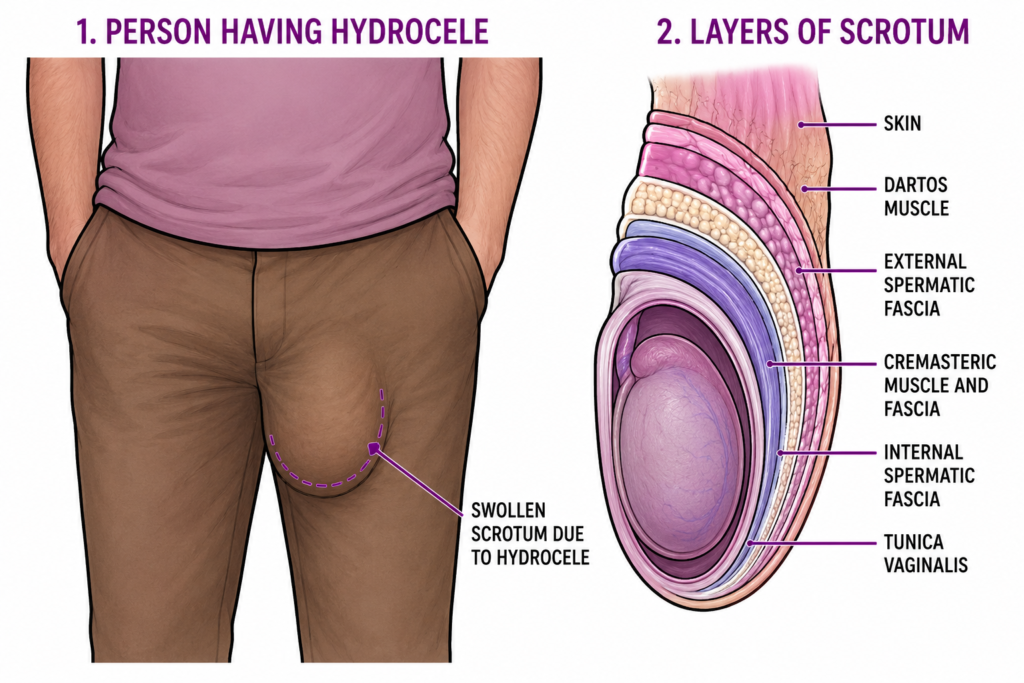
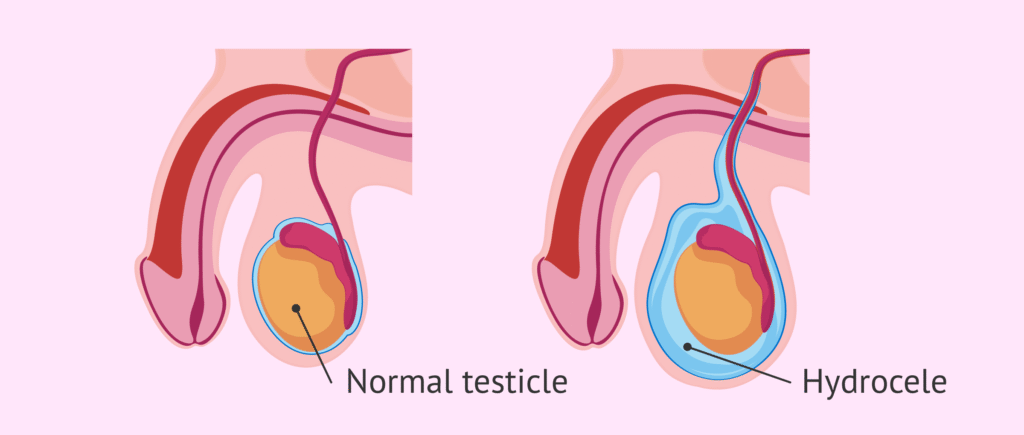
A hydrocele is a collection of fluid around the testicle inside the scrotum, causing it to swell up. It looks like a painless, smooth, soft swelling in the scrotal area. It is not a hernia, not a tumour, and in most cases not dangerous — but it does need proper evaluation and treatment.
Hydrocele is more common than most people think. It is seen in newborn babies, young boys, and adult men of all ages. Many men in our region silently suffer for years out of embarrassment or fear — not knowing that the treatment is simple, safe, and completely curative.
Types of Hydrocele
In Newborns and Infants Most hydroceles in newborn boys resolve on their own within the first 12 to 18 months of life as the small passage between the abdomen and scrotum naturally closes. If it persists beyond 2 years, surgery is recommended.
In Adults Adult hydrocele does not go away on its own. It is caused by inflammation, infection, injury, or sometimes no identifiable cause at all. Surgery is the only permanent cure.
Communicating Hydrocele In this type, the fluid moves between the abdomen and the scrotum — the swelling may appear larger when the child stands and smaller when lying down. This type always requires surgical correction.
What Causes Hydrocele?
- A natural process in newborns where the passage between abdomen and scrotum does not close properly after birth
- Infection or inflammation of the testicle or epididymis
- Injury or trauma to the scrotal area
- Filariasis — a parasitic infection spread by mosquitoes, common in certain parts of Jharkhand and surrounding areas
- Complication after hernia surgery in rare cases
- Sometimes no identifiable cause — known as idiopathic hydrocele
Symptoms — How Do You Know It Is a Hydrocele?
- A smooth, painless swelling in one or both sides of the scrotum
- A feeling of heaviness or dragging sensation in the scrotal area
- The swelling may be small in the morning and larger by evening
- In filaria-related hydrocele, the swelling can become very large over time
- Mild discomfort while walking, sitting, or doing physical work
- In some cases, associated pain if there is an underlying infection
Important: Any new swelling in the scrotal area should be examined by a surgeon. Not all scrotal swellings are hydrocele — some can be serious conditions like testicular cancer that must be ruled out with proper examination and ultrasound.
When Should You See a Surgeon?
See Dr. Vivek Bhaskar without delay if:
- You notice any swelling or enlargement in the scrotal area
- The swelling has been growing slowly over months or years
- You feel heaviness, discomfort, or dragging pain
- A child’s scrotal swelling has not resolved by 18 to 24 months of age
- The swelling is associated with pain or fever — this may indicate infection
- You are embarrassed or hesitant — Dr. Bhaskar handles all such cases with complete sensitivity and confidentiality
Diagnosis — How is Hydrocele Confirmed?
Dr. Bhaskar diagnoses hydrocele through:
- Clinical examination — a simple physical examination is usually enough to diagnose hydrocele
- Transillumination test — shining a light through the swelling; fluid-filled hydrocele glows, solid masses do not
- Scrotal Ultrasound — confirms diagnosis, rules out other conditions including tumours, and assesses the testicle
- Blood tests — if infection or filariasis is suspected
Treatment — What is the Surgery Like?
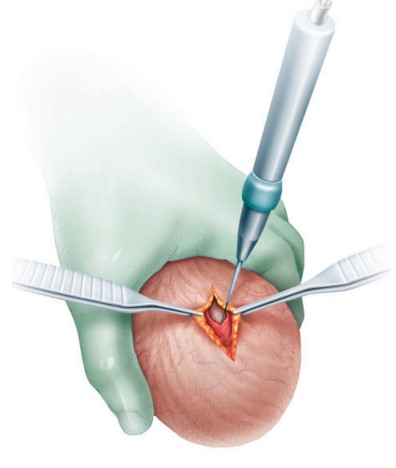
The surgery to remove a hydrocele is called Hydrocelectomy. Dr. Vivek Bhaskar performs this surgery as a well-planned, safe procedure under either Local or Spinal anaesthesia. Dr Vivek Bhaskar gives very small incision for the surgery.
How it is done: A small incision is made in the scrotum or lower abdomen. The fluid sac surrounding the testicle is opened, the fluid is drained, and the sac is either removed or repositioned so fluid cannot collect again. The testicle itself is completely safe and untouched.
The procedure typically takes 30 to 45 minutes. It is clean, effective, and has an extremely high success rate.
For children with communicating hydrocele, the surgery is done through a small cut in the groin to close the passage between the abdomen and scrotum — similar to hernia repair in children.
Is the Surgery Safe? Will It Affect Normal Function?
Yes, hydrocelectomy is a very safe and commonly performed surgery. The testicle is not removed or damaged in any way. Normal hormonal function, sexual function, and fertility are completely preserved after the surgery.
Dr. Bhaskar’s patients regularly return to full, normal life within 1 to 2 weeks of the procedure.
Recovery After Hydrocele Surgery
- Hospital stay: Same day discharge or 1 night admission
- Rest at home: 3 to 5 days
- Light activities: Resume within 1 week
- Return to work: Within 7 to 10 days for desk work; 2 to 3 weeks for physical work
- Avoid heavy lifting: For 3 to 4 weeks
- Scrotal support: A supportive underwear or scrotal support is recommended for 2 to 3 weeks after surgery for comfort and healing
Mild swelling and discomfort after surgery is normal and settles within a few days with prescribed medicines.
What Happens if Hydrocele is Not Treated?
Many men ignore hydrocele for years. While it is not immediately life-threatening, untreated hydrocele can:
- Grow very large over time, causing significant discomfort and difficulty in daily activities
- In filaria-related cases, become extremely large — affecting quality of life severely
- Cause pressure effects on the testicle
- Lead to psychological stress and impact confidence and quality of life
- Hide a more serious underlying condition that goes undetected
There is no reason to live with this condition when the treatment is simple and the recovery is fast.
Hydrocele and Filariasis in Jharkhand
Filariasis — a mosquito-borne parasitic infection — is one of the important causes of hydrocele in Jharkhand and neighbouring regions. In filaria-related hydrocele, the swelling can grow to a very large size over years if not treated. Dr. Bhaskar has treated many such cases from Hazaribagh, Chatra, Ramgarh, Barhi, Barkattha, Barkagaon, Chouparan, Simaria, and surrounding areas. Medical treatment for filariasis combined with surgical correction of the hydrocele gives excellent long-term results.
Why Patients from Across the Region Trust Dr. Vivek Bhaskar
Men from Hazaribagh and nearby areas including Barhi, Barkattha, Vishnugarh, Barkagaon, Chouparan, Ramgarh, Chatra, and Simaria regularly come to Dr. Bhaskar for hydrocele treatment. His reputation is built on three things — surgical skill, genuine care for patients, and a non-judgmental approach that puts even the most hesitant patient completely at ease.
Dr. Bhaskar understands that conditions involving the male reproductive area are deeply personal. Every consultation is handled with the utmost privacy, sensitivity, and respect.
Do Not Be Embarrassed — Be Informed
One of the biggest problems with hydrocele in our region is that men delay seeking help for years — sometimes decades — simply because they feel embarrassed to talk about it or fear what the doctor might say.
The truth is simple. Hydrocele is a common, well-understood, and completely treatable condition. The surgery is minor. The recovery is quick. And the relief — both physical and mental — is immediate.
You owe it to yourself and your family to get it checked.
Book Your Consultation Today
📞 Call / WhatsApp: +91-8521044949 📍 Dr. Vivek Bhaskar | MS (Surgery) | Hazaribagh, Jharkhand
Serving patients from Hazaribagh, Barhi, Barkattha, Vishnugarh, Barkagaon, Chouparan, Ramgarh, Chatra, Simaria and surrounding areas of Jharkhand.
All consultations are completely confidential. Walk in or call for an appointment — whichever is more comfortable for you.