
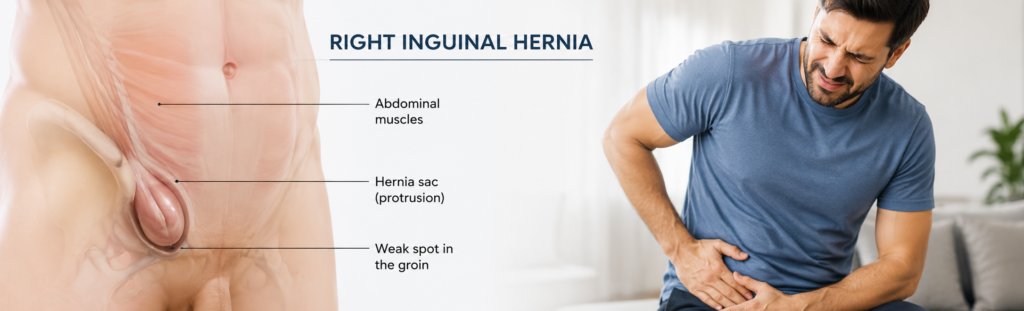
What Is It? A hernia occurs when an internal organ or tissue pushes through a weak spot in the surrounding muscle or connective tissue. It most commonly appears as a visible bulge in the groin (inguinal hernia), belly button (umbilical hernia), or at the site of a previous surgery (incisional hernia). Hernias do not heal on their own — surgery is the only cure.
Symptoms
- A visible lump or bulge in the groin, abdomen, or belly button area
- Aching or burning sensation at the bulge
- Pain or discomfort while bending, coughing, or lifting
- Feeling of heaviness or weakness in the abdomen
- In severe cases — sudden severe pain, nausea, vomiting (strangulated hernia — emergency)
When to See a Surgeon See Dr. Bhaskar promptly if:
- You notice a new or growing lump or bulge anywhere on the abdomen or groin
- The bulge becomes hard, painful, or cannot be pushed back in
- You experience sudden severe pain — this is an emergency requiring immediate surgery
Dr. Bhaskar’s Approach Dr. Bhaskar specialises in both Laparoscopic (keyhole) and Open Hernia Repair, choosing the best method based on the type and severity of the hernia. He uses mesh reinforcement techniques for a durable, long-lasting repair with minimal chances of recurrence. His deep empathy ensures patients are guided through every step of the process with patience and care.
Recovery Time
- Hospital stay: 1–2 days
- Return to light activities: 1 week
- Full recovery: 2–4 weeks
👉 Don’t wait — early treatment leads to faster recovery. Contact Dr. Vivek Bhaskar today! 📞 Call / WhatsApp: +91-8521044949

FAQ — Hernia Surgery Dr. Vivek Bhaskar | Hazaribagh, Jharkhand
Q1. What is a hernia? A hernia occurs when an internal organ or fatty tissue pushes through a weak spot in the surrounding muscle or connective tissue wall. It most commonly appears as a visible bulge or lump in the groin, belly button, or at the site of a previous surgery. It can affect men, women, and even children.
Q2. What are the different types of hernia? The most common types are:
- Inguinal Hernia — in the groin area; most common, especially in men
- Umbilical Hernia — at the belly button; common in newborns and overweight adults
- Incisional Hernia — at the site of a previous surgery scar
- Femoral Hernia — just below the groin; more common in women
- Hiatal Hernia — part of the stomach pushes up into the chest through the diaphragm
Q3. Can a hernia heal on its own without surgery? No. A hernia never heals on its own. It will not go away with medicines, exercises, or belts/trusses. In fact, it tends to grow larger over time. Surgery is the only permanent cure. Delaying treatment increases the risk of serious complications.
Q4. What happens if a hernia is left untreated? An untreated hernia can become dangerous. The tissue pushing through can get trapped and its blood supply can get cut off — a condition called strangulation. This is a surgical emergency causing severe pain, vomiting, and can be life-threatening if not treated immediately.
Q5. What is the difference between laparoscopic and open hernia surgery? In open surgery, a single larger incision is made near the hernia site. In laparoscopic surgery, 3 tiny keyhole incisions are made and the repair is done using a camera and instruments. Laparoscopic surgery means less pain, faster recovery, smaller scars, and quicker return to work. Dr. Bhaskar will recommend the best approach based on the type and size of your hernia.
Q6. What is mesh and why is it used? A mesh is a small piece of surgical net placed over the weak spot in the muscle wall to reinforce it. It acts like a patch and significantly reduces the chances of the hernia coming back. Modern meshes are made of safe, body-compatible materials and are used in the majority of hernia repairs worldwide.
Q7. Is hernia surgery painful? The surgery is performed under anaesthesia so you feel nothing during the procedure. After surgery, there may be mild soreness or discomfort for 2 to 4 days, which is well managed with prescribed pain relief medicines. Most patients are comfortable enough to walk the same day or the next morning.
Q8. How long does hernia surgery take? Laparoscopic hernia repair typically takes 45 minutes to 1 hour. You will spend a couple of hours in the recovery area before being moved to the ward.
Q9. How many days will I be hospitalised? For laparoscopic surgery, most patients are discharged within 1 to 2 days. In straightforward cases, same-day discharge is possible. Open surgery may require a hospital stay of 2 to 3 days.
Q10. How soon can I go back to work and normal activities?
- Light desk work: within 5 to 7 days
- Driving: after about 1 week
- Light household work: within 1 to 2 weeks
- Heavy lifting or physical labour: after 4 to 6 weeks
Dr. Bhaskar will give you personalised guidance based on the type of hernia and repair done.
Q11. Can hernia come back after surgery? With modern mesh repair techniques used by Dr. Bhaskar, the recurrence rate is very low — less than 2 to 3%. Following post-operative instructions, avoiding heavy lifting during recovery, and maintaining a healthy weight all help ensure long-term success.
Q12. I have been wearing a hernia belt — is that enough? A hernia belt or truss can temporarily hold the hernia in place and provide comfort but it is not a cure. It does not repair the weakness in the muscle wall and cannot prevent complications. Surgery remains the only definitive treatment.
Q13. Can children get hernias? Is surgery safe for them? Yes, inguinal and umbilical hernias are quite common in children and infants. Hernia surgery in children is safe and routinely performed. In infants, umbilical hernias often resolve on their own by age 3 to 4 — but any hernia in a child should be evaluated by a surgeon.
Q14. I am elderly — is hernia surgery still safe for me? Age alone is not a barrier to hernia surgery. Dr. Bhaskar regularly operates on elderly patients after careful pre-operative assessment. In fact, delaying surgery in older patients is often riskier than the surgery itself, as the chances of strangulation increase with age.
Q15. What should I avoid after hernia surgery to prevent recurrence?
- Avoid heavy lifting for at least 4 to 6 weeks
- Do not strain during bowel movements — eat high-fibre food and stay hydrated
- Avoid smoking — it weakens tissue healing
- Maintain a healthy body weight
- Follow all follow-up appointments with Dr. Bhaskar
Q16. Do patients from outside Hazaribagh come to Dr. Bhaskar for hernia surgery? Yes. Dr. Vivek Bhaskar is trusted by patients from Barhi, Barkattha, Vishnugarh, Barkagaon, Chouparan, Ramgarh, Chatra, Simaria, and many other surrounding areas. People across this region prefer Dr. Bhaskar for his surgical expertise, use of modern techniques, and his genuinely caring approach toward every patient.
Q17. How do I consult Dr. Vivek Bhaskar? Simply call or WhatsApp on +91-8521044949 to book your consultation. Do not delay — a hernia that is small and manageable today can become a serious emergency tomorrow. Early treatment means easier surgery, faster recovery, and complete peace of mind.