
Dr. Vivek Bhaskar | MS (Surgery) | Hazaribagh, Jharkhand
A Common Problem That Most People Suffer in Silence
Piles, fissure, and fistula are among the most common surgical conditions in India — yet they are also among the most ignored. Out of fear, embarrassment, or simply not knowing what is wrong, many people suffer for years before finally seeking help. By that time, a simple problem has often become much more complicated.
The truth is — these are extremely common, well-understood conditions with safe, effective, and often minimally invasive treatments. There is nothing to be ashamed of, and no reason to delay.

What is Piles (Haemorrhoids)?
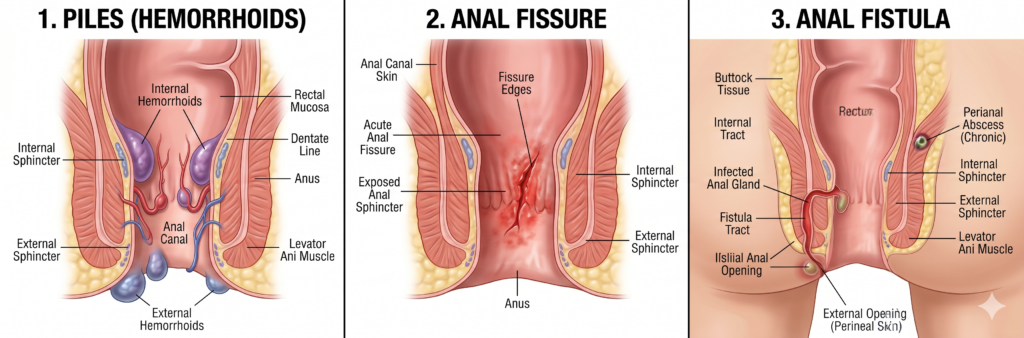
Piles are swollen and inflamed veins in and around the rectum and anus — very similar to varicose veins in the legs. They occur when there is increased pressure on these veins, commonly due to straining during bowel movements, prolonged sitting, constipation, pregnancy, or a low-fibre diet.
Types of Piles:
- Internal Piles — form inside the rectum, often painless but cause bleeding
- External Piles — form under the skin around the anus, can be painful and itchy
Grades of Piles:
Piles are classified from Grade 1 (mild, inside the rectum) to Grade 4 (severe, permanently protruding outside) — the treatment approach depends on the grade.
What is a Fissure?
An anal fissure is a small tear or crack in the lining of the anus. It typically happens due to passing hard stools, chronic constipation, or childbirth. Although small in size, a fissure can cause intense, sharp pain — often described as “passing broken glass” — during and after bowel movements.
What is a Fistula?
An anal fistula is an abnormal tunnel that forms between the inside of the anal canal and the skin outside, usually following an untreated abscess or infection near the anus. It leads to persistent discharge of pus or blood, recurrent swelling, and discomfort. Unlike piles and fissures, a fistula almost always requires surgery — it will not heal with medicines alone.
Common Symptoms to Watch For
- Bright red bleeding during or after passing stools
- Pain, burning, or discomfort around the anus
- Itching or irritation in the anal area
- A lump or swelling that can be felt near the anus
- Sharp, severe pain during bowel movements (typical of fissure)
- Pus or foul-smelling discharge, recurring boils (typical of fistula)
- A feeling of incomplete emptying after passing stools
- In advanced piles, a lump that protrudes outside the anus
What Causes These Conditions?
- Chronic constipation and excessive straining
- Low-fibre diet, low water intake
- Prolonged sitting (common in desk jobs, long travel, or driving)
- Pregnancy and childbirth
- Obesity and sedentary lifestyle
- Heavy lifting or chronic coughing
- Untreated infections or abscess near the anus (leading to fistula)
- Family history in some cases
When Should You See a Surgeon?
You should consult Dr. Vivek Bhaskar promptly if you notice:
- Persistent or repeated bleeding during bowel movements
- Severe or worsening pain in the anal area
- A swelling or lump that does not go away
- Pus discharge, foul smell, or recurring boils near the anus
- A lump that comes out during bowel movements and does not go back in on its own
- Symptoms that have lasted more than 2 weeks despite home care
Important: Bleeding from the anus is often simply due to piles — but it can occasionally be a sign of something more serious. Any persistent bleeding should always be properly examined rather than self-diagnosed.
Diagnosis — What to Expect
Dr. Bhaskar’s evaluation typically involves:
- A detailed discussion of your symptoms and history
- A gentle physical examination of the anal area
- Proctoscopy — a simple, quick examination using a small instrument to view inside the anal canal
- In selected cases, further tests like colonoscopy may be advised to rule out other causes of bleeding
The examination is quick, professional, and conducted with complete privacy and respect for the patient’s comfort.
Treatment Options
For Piles
Mild Cases (Grade 1–2):
Dietary changes, increased fibre and water intake, and medicines are often sufficient. Minor procedures like rubber band ligation may be done in the clinic itself without major surgery.
Moderate to Severe Cases (Grade 3–4):
Dr. Bhaskar performs Stapler Haemorrhoidectomy (MIPH) — a modern, minimally invasive procedure that treats piles with significantly less pain and a much faster recovery compared to traditional surgery. In select cases, laser haemorrhoidectomy may also be offered.
For Fissure
Most early fissures heal with stool softeners, fibre-rich diet, and topical medicines. Chronic or non-healing fissures are treated with Laser Sphincterotomy or minor surgical procedures — quick, effective, and with minimal discomfort.
For Fistula
Fistulas require surgical treatment as they do not heal with medication alone. Depending on the complexity of the fistula tract, Dr. Bhaskar performs Fistulotomy, Fistulectomy, or advanced sphincter-saving techniques to ensure complete healing while protecting normal bowel control.
Why Choose Modern, Minimally Invasive Treatment?
Compared to traditional surgery, the modern techniques used by Dr. Bhaskar offer:
- Significantly less post-operative pain
- Minimal bleeding during the procedure
- Shorter hospital stay — often day care or single-night admission
- Faster return to normal activities and work
- Lower chance of recurrence when properly treated

Recovery After Treatment
- Hospital stay: Day care to 1 night, depending on procedure
- Return to light routine: 3 to 7 days
- Full recovery: 1 to 3 weeks depending on the condition and procedure performed
- Mild discomfort during bowel movements for the first few days is normal and well managed with prescribed medicines and sitz baths (warm water soaks)
What Happens if You Keep Ignoring It?
Many patients delay treatment for months or years, hoping the problem will resolve on its own. Over time:
- Mild piles can progress to more severe, harder-to-treat grades
- Chronic blood loss from piles can lead to anaemia (low blood count) and fatigue
- An untreated fissure can become chronic and much harder to heal
- An untreated abscess can develop into a complex fistula requiring more extensive surgery
- Quality of life, comfort, and confidence are affected daily
The earlier these conditions are treated, the simpler and more effective the treatment.
Tips to Prevent Piles, Fissure and Fistula
- Eat a high-fibre diet — include plenty of vegetables, fruits, and whole grains
- Drink at least 8 to 10 glasses of water daily
- Avoid straining during bowel movements
- Do not delay the urge to pass stool
- Avoid prolonged sitting — take breaks if you have a desk job
- Stay physically active
- Treat constipation early rather than letting it become chronic
Why Patients From Across the Region Choose Dr. Vivek Bhaskar
People from Hazaribagh and surrounding areas — including Barhi, Barkattha, Vishnugarh, Barkagaon, Chouparan, Ramgarh, Chatra, and Simaria — consistently choose Dr. Bhaskar for treatment of piles, fissure, and fistula. His approach combines surgical expertise with genuine compassion, ensuring every patient feels comfortable discussing what is often considered an embarrassing topic.
There Is No Need to Suffer in Silence
These conditions are common. They are treatable. And in Dr. Bhaskar’s care, they are handled with complete confidentiality, sensitivity, and respect — without judgement.
If you have been quietly living with discomfort, bleeding, or pain — today is the day to take the first step toward relief.
Book Your Consultation Today
📞 Call / WhatsApp: +91-8521044949
📍 Dr. Vivek Bhaskar | MS (Surgery) | Hazaribagh, Jharkhand
Serving patients from Hazaribagh, Barhi, Barkattha, Vishnugarh, Barkagaon, Chouparan, Ramgarh, Chatra, Simaria and surrounding areas of Jharkhand.
All consultations are confidential. Discuss your concerns openly — Dr. Bhaskar is here to help, without judgement.